 MiroFish
Football analysis / choose a method
Football prediction AI.
Know what you’re asking it to do.
A probability model, an AI match preview and a scenario simulation answer different questions. Choose the output you need before trusting the confidence of the answer.
MiroFish explores scenarios from your source material. It does not publish a live fixture feed or a measured football win rate.
Football prediction AI uses statistical models or AI systems to estimate outcomes or explain possible match scenarios. A fluent explanation alone does not establish predictive accuracy.
01 / MATCH THE METHOD TO THE JOB
Three approaches. Three different promises.
Start with the result you actually need. Combining tools can help, but their outputs should stay clearly labelled.
| Approach | Useful for | What to bring | Where it can fail |
|---|---|---|---|
| Statistical forecasting | Estimating a home win, draw or away win from a defined model. | Historical results, consistent features and a time-stamped forecast record. | Stale data, changing teams or testing against matches already used for training. |
| Language-model analysis | Organising team news and explaining competing interpretations. | Reliable match notes, current sources and a precise question. | Confident prose can conceal invented facts. Several models can repeat the same mistake. |
| MiroFish scenario analysis | Exploring how a lineup change, tactical assumption or public reaction could alter a preview. | A bounded scenario, source material, actor perspectives and an explicit uncertainty. | Plausible branches are not calibrated win probabilities. Missing evidence remains missing. |
02 / LOOK INSIDE THE ANSWER
Inputs first.
Confidence later.
A useful football prediction AI workflow keeps the evidence attached to the conclusion. If the starting goalkeeper is doubtful, the analysis should preserve that uncertainty rather than quietly choose a lineup.
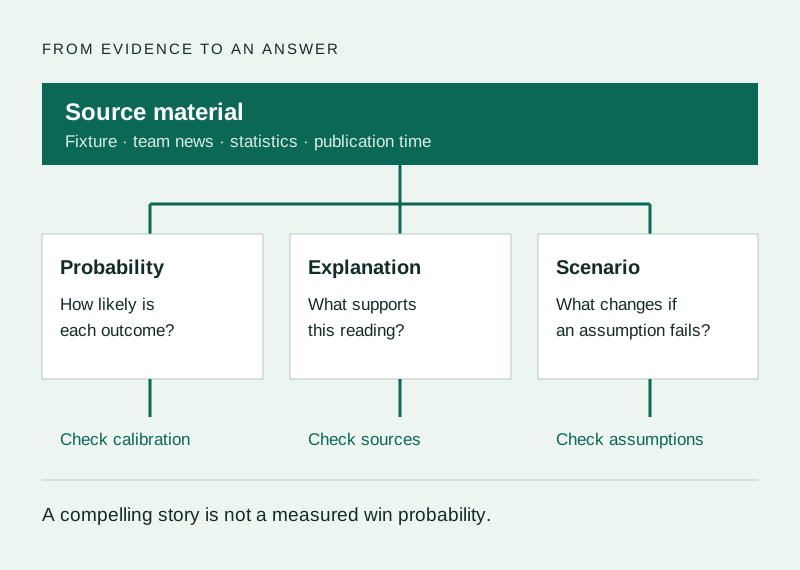
The next step depends on the claim. For a probability, ask how forecasts performed over a defined set of matches. For a written preview, check the sources. For a scenario, ask which assumption would change the branch.
Public examples show different approaches: Predicd presents match probability and form tables, while ScoreGPT presents model picks and graded results. These are examples of output formats, not endorsements of their accuracy.
03 / BEFORE YOU CHOOSE A TOOL
Five things a prediction should make clear.
- The outcome being predicted
A regulation-time home win, an exact score and a team qualifying are different targets. An accuracy percentage is meaningless until the target is clear.
- When the evidence was collected
Check the date, kickoff timezone and whether the analysis used confirmed or projected lineups. A sound preview can become outdated after late team news.
- The complete record
Look for misses as well as wins, the number of forecasts, the date range and whether predictions were recorded before kickoff. A selected screenshot cannot establish a track record.
- What “confidence” means
Model agreement is a count of opinions. A calibrated probability is a claim about observed frequencies. One does not automatically establish the other.
- The missing information
A useful tool can say it does not know. If an injury source is unavailable, a player’s status should remain unknown rather than become a convenient fact.
When MiroFish fits
Use MiroFish when you already have a match brief and want to challenge its story. A preview writer might compare what changes if a key midfielder starts, misses the match or appears from the bench.
The useful output is a report with competing branches, weak assumptions and questions to resolve. That can improve a preview without pretending to measure a sporting outcome.
When another tool fits better
If you need today’s fixture list, confirmed lineups or a numerical win-probability feed, start with a service that actually supplies those data. Bring the relevant evidence into MiroFish afterwards.
If you need a validated forecasting model, require a documented evaluation. MiroFish does not claim an independently measured football prediction accuracy or guaranteed correct scores.
A WORKED COMPARISON
Assessing football prediction AI accuracy
Imagine two football services both advertise “70% correct.” The first records every league fixture before kickoff. The second displays seven successful picks from ten featured matches but does not explain how those matches were selected. The percentages look identical; the evidence does not.
Before comparing football prediction AI accuracy, write down the forecast target, the selection rule and the full set of results. A service that only selects strong favourites may get more winners right than one covering every fixture. That alone does not show that its AI is better: the tasks differ.
A practical comparison uses the same football matches, the same information cutoff and the same definition of a correct prediction. Save each original prediction before play begins. Include postponed fixtures and missing forecasts in the record with an explicit treatment, rather than quietly removing inconvenient rows.
For a numerical football model, also keep the probabilities. Two systems can choose the same winner while making very different confidence claims. Whether those claims are reliable requires a larger, comparable forecast history; one weekend cannot settle it.
Match the evidence to the promise
For an AI-written preview, start with a different question: can a reader trace each important claim to the supplied football sources? A correct final prediction does not excuse an invented injury or a wrongly identified home team.
For a scenario report, inspect conditional reasoning. If the football brief says a midfielder’s availability is unknown, useful branches retain both possibilities and explain what changes. A report that silently declares the player available has lost the premise, even if its match story sounds convincing.
Keep a short decision record: which output you needed, what evidence you supplied, what the football tool actually returned, and what remained unresolved. This makes the next comparison easier and prevents a persuasive paragraph from becoming an unsupported accuracy claim.
Choose football prediction AI by the work it demonstrably helps you do. If the task is clearer source-based reasoning, use a scenario workflow. If it is tested match probabilities, require a forecasting record that supports that specific claim.
Football prediction AI questions
Can football prediction AI guarantee the result?
No. An estimate or scenario is not the result itself. Football includes uncertainty, and the model may also have missing or incorrect inputs. Treat any guarantee as a reason to examine the claim carefully.
Is the highest-confidence prediction always the best one?
No. Confidence labels differ between tools. Ask whether the label represents a tested probability, model agreement or an editorial rating before comparing it with another system.
Does MiroFish provide today’s football picks?
No. This page helps you choose an analysis approach. MiroFish uses the material you provide to explore scenarios; it does not provide a live daily picks service.
Can I compare a model forecast with a MiroFish scenario?
Yes. Include the forecast, its date, the available inputs and the uncertainties in your brief. Ask MiroFish which assumptions support the story and which developments would undermine it. Do not present the scenario as a new measured probability.
Continue your analysis
Updated September 17, 2026. Football here means association football (soccer).