 MiroFish
Match result / 1X2
Home win, draw or away win, usually for regulation time including added time. Read the provider’s definition; never assume a label includes extra time.
Read the match / not just the number
A home win, a 2–1 scoreline and a team advancing are three different claims. Read the outcome and the time boundary before you read the confidence score.
Soccer means association football. MiroFish explores scenarios from your evidence; this page does not supply live match picks.
Explore the 1X2 shorthand
Choose an outcome to see what it describes.
“1” means the home side finishes regulation time ahead. It does not tell you the exact score or the winning margin.
Definitions only. These buttons do not predict a fixture.
01 / SET THE TIME BOUNDARY
An AI soccer prediction estimates or analyses a possible soccer outcome. The question must identify whether that outcome concerns regulation time, the exact score, or advancement in a competition.
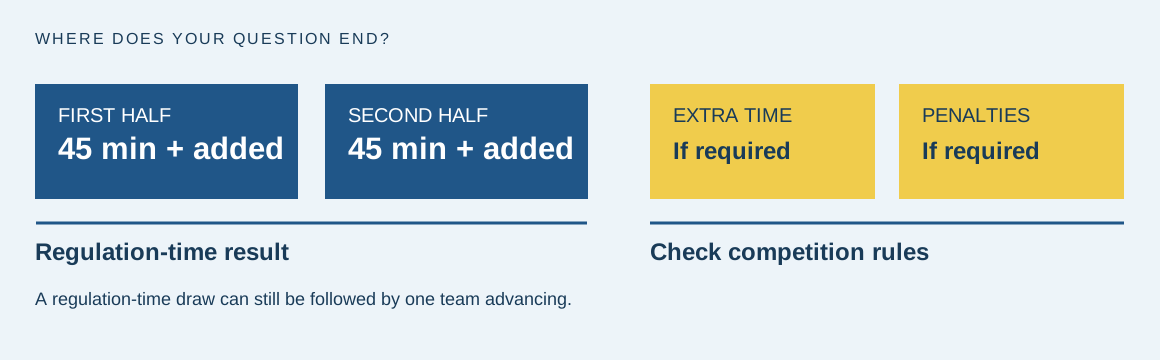
IFAB Law 7 sets the standard match at two 45-minute halves and allows for time lost. Law 10 defines equal goals as a draw and describes permitted procedures when competition rules require a winner. Extra time, when used, has two equal periods of no more than 15 minutes each.
02 / READ THE CLAIM PRECISELY
A model can name the eventual winner while missing the scoreline. That is why result accuracy and exact-score accuracy need separate records. Comparing the two percentages as if they measure the same task makes a model look better or worse for the wrong reason.
For a full home/draw/away probability distribution, the three probabilities should total 100%, allowing for rounding. The most likely outcome can still be less likely than all the alternatives combined.
MiroFish’s scenario reports are qualitative. Do not assign probabilities to their branches unless a separate, justified method supports those numbers.
03 / A SMALL SOCCER FORECAST GLOSSARY
Home win, draw or away win, usually for regulation time including added time. Read the provider’s definition; never assume a label includes extra time.
The specific number of goals for each team at the stated endpoint. It is a narrower claim than correctly naming the winner.
Which team advances. That can depend on an aggregate score or a competition’s tiebreak procedure, not simply who wins one match in regulation time.
How many models selected the same answer. Agreement describes the models; it is not automatically the probability that the answer is correct.
Whether predicted probabilities match observed frequencies over enough comparable forecasts. A model’s confidence needs evidence beyond a few successful picks.
A conditional account of what could happen if an assumption holds. It helps you inspect a story; it is not, by itself, a statistically measured forecast.
“Who wins?” leaves too much unresolved. A better question names the fixture, competition, date, venue and outcome boundary. It then identifies the uncertain fact you want to explore.
For example: “Compare regulation-time match narratives if the doubtful midfielder starts or is unavailable. Use only the attached team news. Keep the qualification question separate.”
The value is not a more confident sentence. It is a report whose assumptions can be checked. Start with the football briefing guide if your notes are still scattered.
Future injuries, officiating decisions and unusual match events remain uncertain. A source may also be stale or incorrect. More polished reasoning does not remove those limits.
This guide fits fans and writers who want to understand a forecast and formulate better questions. If you need a live score, confirmed lineup or probability feed, use a service that provides that data directly. MiroFish is not a substitute for it.
READ A COMPLETE DISTRIBUTION
Consider an illustrative AI soccer prediction that assigns 45% to a home win, 30% to a draw and 25% to an away win. These invented numbers total 100%. Home win is the single most likely result, yet the other two results together account for 55%.
A draw would therefore not, by itself, prove that the soccer prediction was badly calibrated. The model gave that outcome a substantial probability. To assess its probability claims, keep many forecasts made before kickoff and compare similar probability ranges with their observed results.
This differs from checking the top-choice prediction alone. A simple record of correct winners discards how confidently each winner was selected. Both records can be useful, but label them clearly so a reader knows which soccer forecasting task is being evaluated.
The example explains probability language only. MiroFish does not generate these percentages through a validated soccer forecasting model, and an AI scenario report should not inherit them simply because the narrative sounds plausible.
Now imagine a knockout soccer match that is level after regulation time and is decided later. “Draw after regulation” and “home team advances” can both be correct. An AI soccer prediction needs its endpoint before either statement can be scored.
Keep separate fields for the original prediction, its timestamp, the match period and the observed outcome. For a two-leg tie, also record whether the question concerns one match or the aggregate result. Check the competition’s published rules before interpreting qualification.
Do the same with exact scores. A 2–1 prediction is more specific than “home win,” so retain both claims in a review. Do not retroactively turn a missed exact score into a fully correct soccer prediction just because the winning side matched.
When bringing an external forecast into MiroFish, include its original label and definition with your source notes. Ask the AI to explain the soccer assumptions and alternative narratives. Keep the external probability, the actual result and the qualitative scenario report distinguishable.
Here, no: both refer to association football. American football is a different sport with different scoring, inputs and outcomes. Check which sport a provider covers before using its analysis.
Yes. A regulation-time draw and a team advancing can both be correct descriptions. The competition rules determine whether aggregate scores, extra time, penalties or another permitted procedure applies.
No. If that probability is well calibrated, comparable 60% forecasts should succeed around 60% of the time over a sufficiently large set. It does not guarantee an individual result.
MiroFish is used here for scenario analysis from supplied evidence. It can help compare narratives and assumptions, but this workflow does not claim calibrated match probabilities or a measured soccer prediction accuracy.
Updated September 17, 2026. Rules are linked above; check the applicable competition regulations for a specific fixture.