 MiroFish
Establish the context
Record the competition, venue, recent fixtures and the source of each result. Keep home and away form separate where relevant. Do not treat a cup tie and a league match as interchangeable.
From match question to scenario analysis
Enter the match, your question and source notes directly in MiroFish. Explore how the match story could change, with the evidence and unknowns in view.
Add your details in the console and review them before starting the analysis.
01 / REFRESH THE FACTS AT THE RIGHT MOMENT
AI football prediction is the use of models to estimate or analyse possible match outcomes. This workflow prepares the evidence for scenario analysis; it does not calculate a win probability.
Record the competition, venue, recent fixtures and the source of each result. Keep home and away form separate where relevant. Do not treat a cup tie and a league match as interchangeable.
Check the club or competition’s official updates. Distinguish confirmed absences, doubtful players and projected lineups. Keep contradictory reports in the brief instead of silently selecting one.
Compare the report with what happened. Preserve the original brief so late information cannot rewrite the story. Note whether the key assumption held, even when the result went the other way.
02 / MAKE THE SOURCE PACKET USABLE
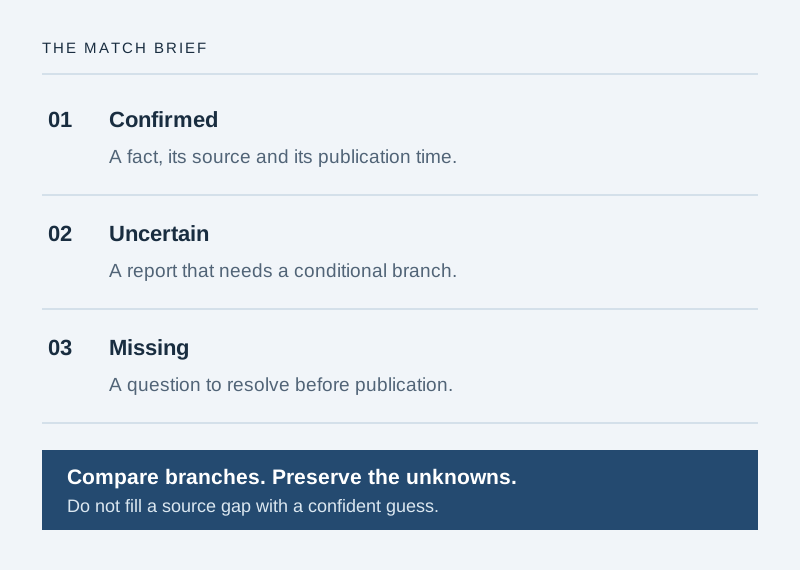
A club announcement that a player is unavailable is a fact about availability. The idea that the absence weakens the press is an interpretation. A projected replacement is still uncertain until supported by team news.
Keep those statements separate. Give each source a date, name the relevant player or role, and include information that challenges your preferred reading. A one-sided source packet tends to produce a one-sided story.
You can attach your source material in the MiroFish console. Review the report against those sources before using it in a published preview.
03 / ASK FOR ALTERNATIVES
A useful AI football prediction brief asks what makes the story hold together. The following are analytical questions, not forecasts for an actual fixture.
If your question is about the result, define the time boundary. Under IFAB Law 7, a standard match has two 45-minute halves with allowance for time lost; half-time normally cannot exceed 15 minutes. A qualification question may require a different boundary.
Assuming the available team news is correct, what is the strongest case for the initial reading? Which facts support it?
What plausible tactical response or interpretation would challenge that reading? Does it depend on evidence, or only on a possible story?
Which unknown matters most? Ask for separate branches if a doubtful player starts or misses the match, without inventing the answer.
A FICTIONAL WORKING EXAMPLE
The teams and circumstances below are invented to demonstrate the structure. They are not current football news, a fixture recommendation or an AI forecast.
Suppose Northbridge host Eastport in a league match. Your notes say Northbridge played recently, Eastport changed formation in their last outing, and Northbridge’s holding midfielder may be unavailable. Those statements still need sources and dates before they belong in an actual football preview.
Your AI football prediction brief could ask: “How does the regulation-time match narrative change if the holding midfielder starts, or if a replacement plays? Separate confirmed football facts from tactical interpretations. Explain what evidence would support each branch.”
This gives the AI an analytical task with a clear boundary. It does not ask the system to manufacture a football result from incomplete notes. If the latest team news is missing, say so explicitly; include that gap in your football question in the console.
Record why each detail matters. Recent fixtures may motivate a fatigue question, but they do not prove fatigue. A different formation may change a football matchup, but one appearance does not establish a permanent tactical switch.
Read your AI football prediction brief beside the returned report. Check whether the AI kept both availability branches, used the stated match endpoint and distinguished source facts from interpretation. Remove any football claim that the supplied material cannot support.
If official team news arrives later, save a new version with a new timestamp. Keep the earlier prediction brief intact so you can explain which information changed the analysis. Updating an input is useful; rewriting the old version makes an honest comparison harder.
After the football match, record the final result and what happened to the central assumption separately. The midfielder might start while an unrelated red card changes the game. That does not validate every argument in the AI report or make every earlier prediction unreasonable.
Use these notes to improve the next football question: which information was missing, which interpretation proved too strong, and which follow-up would have been useful? This is a repeatable review habit, not a claimed MiroFish accuracy score.
A readable scenario report should distinguish source facts, assumptions, alternative narratives and the next evidence to check. For a media preview, keep fan and press reactions separate from claims about on-pitch performance.
The benefit is a clearer question and a more reviewable explanation. It is useful to writers and analysts who can judge the evidence. It is a poor fit for someone expecting instant live picks or an automatic final score.
MiroFish can reason from a weak premise as fluently as a strong one. Check important source claims yourself, especially player availability, competition rules and the age of the data.
Do not turn a confident paragraph into a confidence percentage. If you want to compare predictive performance, use forecasts recorded before kickoff and a clearly defined outcome. A few memorable correct calls are not enough.
Open the MiroFish console and enter your match question there. Add fixture details and source material in the same workspace, review the input, then start the scenario analysis.
Bring official fixture information, club or competition team news, and relevant statistics from sources you can inspect. Include publication dates and links. Clearly label opinion and unconfirmed reports.
Keep the status as not confirmed. Ask for separate branches around the important uncertainty and refresh the brief when official team news arrives. Do not let the analysis invent a starting eleven.
No. The button opens the MiroFish workspace. You enter your question and sources there, then review them before choosing to start an analysis.
Updated September 17, 2026. This guide concerns association football (soccer).