Can a reader see the team, form, home/away, injuries, and odds context?
AI model review
Football predictions AI should explain the model, the inputs, and the uncertainty
A football predictions AI page is stronger when it shows how the prediction was formed. MiroFish helps compare model output, human news checks, match context, and calibration questions before any preview is published.
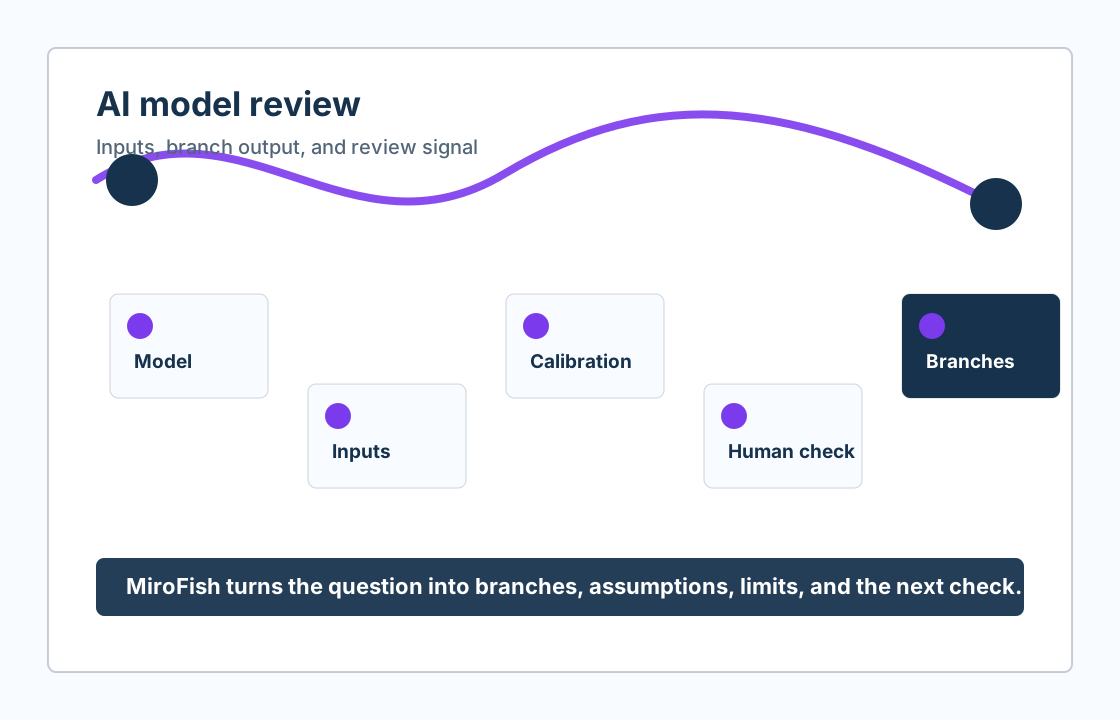
Has the model been compared against past probabilities, not just wins?
Who checks late team news before publishing?
Does the page explain branches or just push a pick?
AI output needs a human refresh before kickoff
The model can be useful and still become stale when team news changes. Treat MiroFish as a review surface, not an auto-publish switch.
Model review
football predictions ai: explain the model before the pick
Football predictions AI is only useful when the reader can see what the model considered. Team strength, recent form, injuries, home advantage, rest, fixture congestion, and market context are not optional details. If the inputs are hidden, the output becomes a black box with a confident voice.
A credible page should ask calibration questions. Has the model been checked against probabilities, or only remembered when it guessed correctly? Does it separate league quality from recent noise? Does it know late lineup changes? Football predictions AI should make these questions visible before a reader trusts the preview.
MiroFish can act as a review layer around model output. Paste the AI prediction, inputs, missing facts, and team news. Ask for branches that explain when the model might be right, when it might be stale, and which human check should happen before publication. That makes the output more accountable.
The page should distinguish machine output from editorial judgment. A model may produce a probability, but the final preview still needs human context: injuries, motivation, travel, tactical matchup, and whether the match has an unusual incentive. The reader should see both the calculation and the caveat.
The CTA should invite review, not blind automation. Open the console with a model preview, ask for missing inputs, and remove language that sounds certain. That is the practical value of football predictions AI for content teams that need speed without dropping judgment.
Input disclosure
List the team, form, home/away context, injuries, and match factors behind the output.
Calibration check
Ask whether probabilities were evaluated over many matches rather than a few remembered wins.
Human refresh
Late team news and motivation still need a person before publication.
Output boundary
Branches and confidence notes are more useful than unexplained picks.
Reader arrives with
A model-generated preview or a question about whether AI predictions are credible.
Best first action
Expose inputs, missing facts, and freshness risks.
Best MiroFish output
A review memo with branches, calibration questions, and human checks.
Claim to avoid
Football predictions AI presented as an auto-publish authority.
Use MiroFish after the model output exists. The console can make football predictions AI easier to trust by showing assumptions, uncertainty, and the human refresh that must happen before kickoff.
Working notes
How to use this football predictions ai without overclaiming
The best version of a football predictions ai is specific, dated, and easy to review. A reader should understand the official facts, the assumptions, the entertainment or research boundary, and the last check that belongs outside the model before they follow a call to action.
Facts to keep visible
Model inputs matter: Football prediction models commonly rely on team strength, recent form, home advantage, and match context. Method pages help trust: Public predictor pages that explain method and limits are more useful than unexplained picks. Fresh news matters: Lineups and injuries can make model output stale before kickoff. These details make the page useful because they give the reader a factual anchor before any scenario, calculator, quiz, or number note appears.
Comparison examples
Squawka AI predictor methodology is useful for seeing AI method page with model explanation; ScoutingStats football ML is useful for seeing machine-learning inputs and model concepts; Forebet football predictions is useful for seeing prediction table and match probability pattern. Those examples show common reader expectations, but the MiroFish page should still add a clearer review path, a safer boundary, and a natural next step into the console.
For football predictions ai, the first pass should not try to sound final. It should collect the smallest complete packet of evidence: the exact game, market, match, draw, quiz context, or calculator input; the source that confirms the official rule; and the assumption that would change the conclusion. That packet lets the reader see why the output exists.
The Audit lane turns the topic into action. Input visibility: Can a reader see the team, form, home/away, injuries, and odds context? Calibration question: Has the model been compared against past probabilities, not just wins? Human refresh: Who checks late team news before publishing? Output type: Does the page explain branches or just push a pick? If one of those pieces is missing, the page should say what must be checked next. That is more helpful than a confident sentence that hides uncertainty.
The console handoff should be phrased as a working brief. Ask MiroFish to compare branches, label weak evidence, and name the review signal that would make the draft safer. Do not ask it to promise a score, a winning ticket, a baby outcome, an investment result, or a guaranteed match pick.
Reader trust depends on boundaries. What makes football AI credible? Transparent inputs, calibration, freshness checks, and limits. Is this a betting model page? No. It frames preview quality and uncertainty, not betting instructions. How does MiroFish help? It can compare model output with actor narratives and late-news risk before publication. Those answers belong close to the call to action because they explain what the page can do and what it cannot do. A clear boundary makes the CTA feel useful instead of pushy.
The final review is simple: confirm the official source, refresh any time-sensitive input, remove certainty language, and keep the next step aligned with the reader's real task. If the reader wants more context, the predictions hub provides adjacent workflows; if they are ready to build the brief, the console is the right destination.
Football prediction models commonly rely on team strength, recent form, home advantage, and match context.
Check sourcePublic predictor pages that explain method and limits are more useful than unexplained picks.
Check sourceLineups and injuries can make model output stale before kickoff.
Check sourceConsole handoff
Review the model before publication
Review a football predictions AI output. List the model inputs, missing inputs, calibration questions, human news checks, likely match branches, and wording that should be removed because it sounds certain.
Open console for AI preview reviewfootball predictions ai FAQ
What makes football AI credible?
Transparent inputs, calibration, freshness checks, and limits.
Is this a betting model page?
No. It frames preview quality and uncertainty, not betting instructions.
How does MiroFish help?
It can compare model output with actor narratives and late-news risk before publication.