Each NFL team plays 17 regular-season games across an 18-week schedule.
Check sourceNFL simulation board
NFL predictions simulator for branch-based season and matchup thinking
Use this page when you want a simulation-style NFL preview without pretending one model can know the final score. MiroFish helps separate schedule pressure, roster news, matchup stories, public narratives, and the next evidence to check.
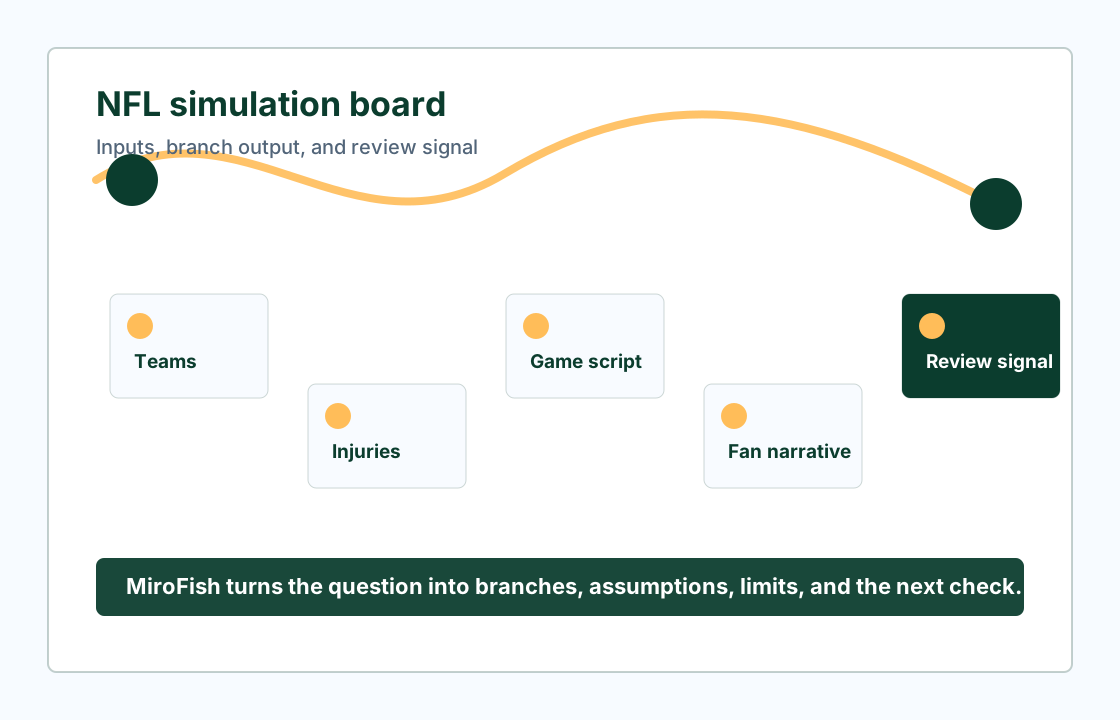
A responsible simulator should return branch narratives, not guaranteed picks.
Check sourceLineups, injuries, weather, and odds can change after a preview is drafted.
Check sourceSimulator sequence
Build the game board before the branch run
Teams, date, venue, rest, travel, and matchup question.
List injuries, roster moves, weather, and market movement that can still change.
Base game script, upset path, slow-start path, and late-volatility path.
Remove claims that depend on stale news or a single unsupported pick.
Good input
A concise matchup brief with links, injury status, and one question such as "what changes if the favorite starts slow?"
Good output
A branch report: likely game scripts, fragile assumptions, fan-reaction paths, and review signals.
Do not use it for
Selling betting locks, copying odds as certainty, or hiding that NFL news changes quickly.
Preview desk
nfl predictions simulator: a fuller working method
An nfl predictions simulator works best when it behaves like a preview desk, not a magic score machine. Start with the boring facts: opponent, venue, rest difference, travel, injury designation, surface, weather, and the part of the matchup that could change the game. That discipline keeps the page useful even when the final score is unknowable.
The reader should be able to see why each branch exists. A favorite-control branch might depend on offensive line health and early-down success. An upset branch might depend on turnovers, special teams, or a quarterback under pressure. A low-total branch might depend on pace, weather, and red-zone fragility. The simulator should name those conditions plainly.
Freshness matters more in the NFL than a polished paragraph. A preview written before practice reports, inactive lists, or weather updates can become stale quickly. Treat every output as a dated brief: what was known, what was assumed, and which late signal would change the story. That makes the nfl predictions simulator safer for editors and readers.
MiroFish is useful after the source packet is ready. Paste a tight brief rather than a pile of links: team names, date, injury notes, recent performance, public narrative, and the exact question. Ask for a base script, an upset script, and a volatility script. Then remove any sentence that turns a branch into certainty.
A good final page separates preview language from betting language. It can discuss matchups, pressure, and uncertainty, but it should avoid selling locks or implying that a model has hidden knowledge. The most helpful output is a reviewable explanation: here are the paths, here is what would break them, and here is the last thing to check before publishing.
Game board
Record teams, kickoff time, surface, weather, rest, travel, and the one matchup question the reader actually wants answered.
Uncertainty window
Mark injuries and late news as live variables so the preview does not pretend yesterday's information is final.
Branch output
Return a base path, upset path, slow-start path, and late-volatility path with the evidence behind each one.
Review action
Before sharing, remove score certainty, stale injury language, and unsupported claims about guaranteed outcomes.
Reader arrives with
A matchup, a week, or a team question that needs context before a preview.
Best first action
Gather official schedule and injury status, then write one narrow simulation question.
Best MiroFish output
Branches, assumptions, fragile signals, and a final evidence checklist.
Claim to avoid
Any sentence that says the nfl predictions simulator knows the final score.
Use the console when the brief is specific enough to test. If the only input is a team name and a wish, keep gathering facts. If the input already names matchup pressure, roster uncertainty, and a review deadline, MiroFish can turn that into a useful nfl predictions simulator note.
Working notes
How to use this nfl predictions simulator without overclaiming
The best version of a nfl predictions simulator is specific, dated, and easy to review. A reader should understand the official facts, the assumptions, the entertainment or research boundary, and the last check that belongs outside the model before they follow a call to action.
Facts to keep visible
NFL regular season format: Each NFL team plays 17 regular-season games across an 18-week schedule. Useful simulator output: A responsible simulator should return branch narratives, not guaranteed picks. Review boundary: Lineups, injuries, weather, and odds can change after a preview is drafted. These details make the page useful because they give the reader a factual anchor before any scenario, calculator, quiz, or number note appears.
Comparison examples
TeamRankings NFL predictions is useful for seeing prediction tables, matchup odds, week-by-week outcome estimates; Covers NFL predictions is useful for seeing game preview copy, betting boundary, expert notes; Squawka AI predictor methodology is useful for seeing methodology explanation, probability model, limits. Those examples show common reader expectations, but the MiroFish page should still add a clearer review path, a safer boundary, and a natural next step into the console.
For nfl predictions simulator, the first pass should not try to sound final. It should collect the smallest complete packet of evidence: the exact game, market, match, draw, quiz context, or calculator input; the source that confirms the official rule; and the assumption that would change the conclusion. That packet lets the reader see why the output exists.
The Board lane turns the topic into action. 1. Frame the game: Teams, date, venue, rest, travel, and matchup question. 2. Separate news from noise: List injuries, roster moves, weather, and market movement that can still change. 3. Run branches: Base game script, upset path, slow-start path, and late-volatility path. 4. Review before publishing: Remove claims that depend on stale news or a single unsupported pick. If one of those pieces is missing, the page should say what must be checked next. That is more helpful than a confident sentence that hides uncertainty.
The console handoff should be phrased as a working brief. Ask MiroFish to compare branches, label weak evidence, and name the review signal that would make the draft safer. Do not ask it to promise a score, a winning ticket, a baby outcome, an investment result, or a guaranteed match pick.
Reader trust depends on boundaries. Can this predict an NFL score? It can organize plausible game scripts, but it should not be treated as a guaranteed score predictor. What should I verify last? Official injury status, active/inactive news, weather, and late market movement. Where does MiroFish fit? Use MiroFish after gathering the brief, then review the branches before publishing a preview. Those answers belong close to the call to action because they explain what the page can do and what it cannot do. A clear boundary makes the CTA feel useful instead of pushy.
The final review is simple: confirm the official source, refresh any time-sensitive input, remove certainty language, and keep the next step aligned with the reader's real task. If the reader wants more context, the predictions hub provides adjacent workflows; if they are ready to build the brief, the console is the right destination.
Console handoff
Ask for branches, not a locked pick
Preview this NFL matchup as scenario branches, not a betting pick. Use the teams, date, venue, roster news, injuries, travel/rest context, market narrative, and public reaction. Return base, upset, slow-start, and late-volatility branches with the evidence that would change each branch.
Open console with an NFL briefnfl predictions simulator FAQ
Can this predict an NFL score?
It can organize plausible game scripts, but it should not be treated as a guaranteed score predictor.
What should I verify last?
Official injury status, active/inactive news, weather, and late market movement.
Where does MiroFish fit?
Use MiroFish after gathering the brief, then review the branches before publishing a preview.