Random quick pick
Useful when the reader only wants an unbiased set for entertainment.
Number notebook
People search this phrase because they want numbers quickly. A better page slows the moment down: confirm the game, show that random combinations stay random, and keep any numbers as an entertainment choice rather than a promise.
Useful when the reader only wants an unbiased set for entertainment.
Useful as a personal ritual, but often clustered around dates and familiar ranges.
Should be labeled as a system preference, not a statistical advantage.
Also valid when the budget or mood makes the draw a bad idea.
They are an entertainment choice. They are not proof, a signal, or a hidden edge.
Open console with number notebookNumber notebook
Lottery prediction numbers pages often fail by acting as if a list can beat randomness. A more useful page starts with the exact game. Which lottery is being played, what number ranges apply, how many numbers are needed, and what rules change the prize structure? Without that, the numbers may not even fit the game.
After the game is clear, the reader can choose a method for entertainment. Random quick picks, favorite numbers, saved combinations, and pattern systems can all be documented, but none should be described as proof of better odds. The page should label each method in plain language so the reader understands what it is and what it is not.
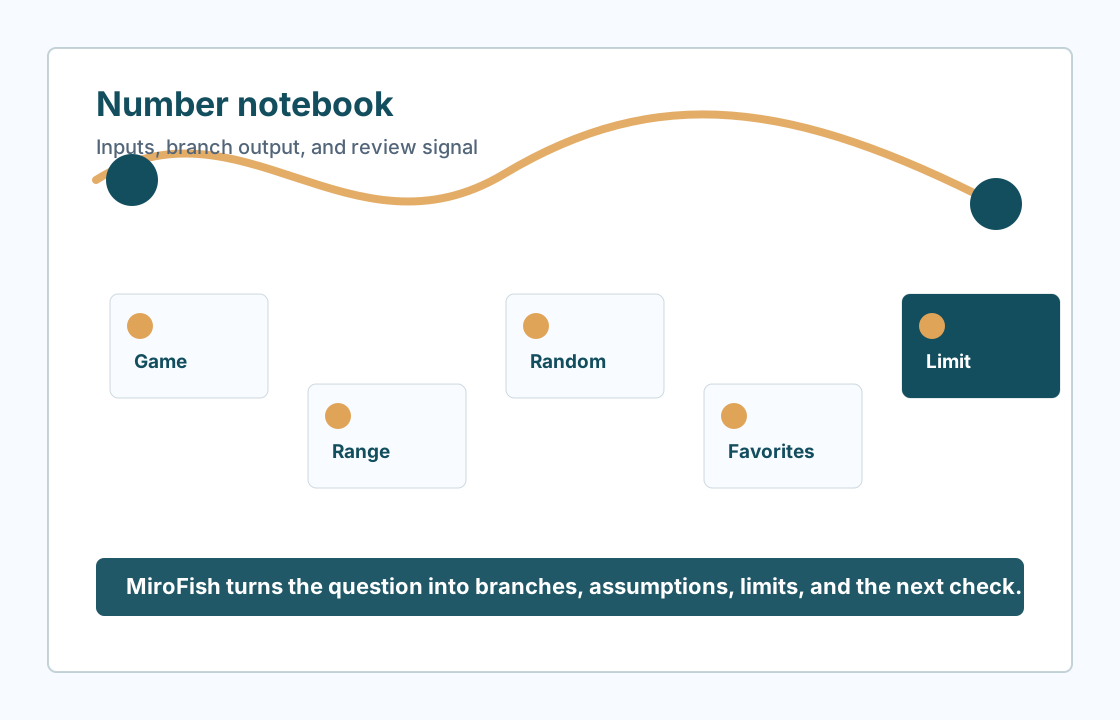
MiroFish can turn the activity into a notebook. Ask for the game, range, exclusions, preferred method, and spend limit. The output should return a number set, a short explanation of how it was chosen, the official rule reminder, and a loss boundary. That is more honest than a lucky-number headline.
The page should make room for the decision not to play. If the reader is tired, chasing losses, or uncomfortable with the spend, the best number is no number. Adding that branch protects the reader and makes the content more useful than a list of combinations.
Use sources close to the claim. Official rules belong near number ranges. Odds belong near any example that could sound persuasive. Community discussion can illustrate rituals, but it should not become evidence. Lottery prediction numbers stay entertainment when those boundaries remain visible.
Start with the lottery name, draw type, number range, and local rules.
Label random, favorite, saved, or pattern-based numbers as entertainment methods.
Reject any generated set that falls outside the official number pool.
Put the loss limit beside the number set, not in a hidden footer.
Use the console when the reader wants a structured note rather than a promise. MiroFish should keep lottery prediction numbers clear: valid ranges, honest method, visible odds, and a stop point before any ticket is bought.
Working notes
The best version of a lottery prediction numbers is specific, dated, and easy to review. A reader should understand the official facts, the assumptions, the entertainment or research boundary, and the last check that belongs outside the model before they follow a call to action.
Game rules vary: Lottery number ranges, prize rules, and purchase rules vary by game and jurisdiction. Powerball jackpot odds example: Powerball jackpot odds are 1 in 292,201,338. Number ritual boundary: Favorite numbers may be memorable, but they should not be described as more likely without valid evidence. These details make the page useful because they give the reader a factual anchor before any scenario, calculator, quiz, or number note appears.
Lottery.net is useful for seeing game pages, result tables, number tools; Random.org quick pick is useful for seeing random number generation pattern; Lottery Post discussion is useful for seeing community number-picking habits and skepticism. Those examples show common reader expectations, but the MiroFish page should still add a clearer review path, a safer boundary, and a natural next step into the console.
For lottery prediction numbers, the first pass should not try to sound final. It should collect the smallest complete packet of evidence: the exact game, market, match, draw, quiz context, or calculator input; the source that confirms the official rule; and the assumption that would change the conclusion. That packet lets the reader see why the output exists.
The Compare lane turns the topic into action. Random quick pick: Useful when the reader only wants an unbiased set for entertainment. Favorite numbers: Useful as a personal ritual, but often clustered around dates and familiar ranges. Pattern systems: Should be labeled as a system preference, not a statistical advantage. No-play decision: Also valid when the budget or mood makes the draw a bad idea. If one of those pieces is missing, the page should say what must be checked next. That is more helpful than a confident sentence that hides uncertainty.
The console handoff should be phrased as a working brief. Ask MiroFish to compare branches, label weak evidence, and name the review signal that would make the draft safer. Do not ask it to promise a score, a winning ticket, a baby outcome, an investment result, or a guaranteed match pick.
Reader trust depends on boundaries. Can this page recommend lucky numbers? It can provide an entertainment notebook, but it should not promise luck or better odds. Why include official rules? Because number ranges and purchase rules are game-specific. Wrong ranges make the page useless. What is the best boundary? Write the spend limit and loss case before choosing numbers. Those answers belong close to the call to action because they explain what the page can do and what it cannot do. A clear boundary makes the CTA feel useful instead of pushy.
The final review is simple: confirm the official source, refresh any time-sensitive input, remove certainty language, and keep the next step aligned with the reader's real task. If the reader wants more context, the predictions hub provides adjacent workflows; if they are ready to build the brief, the console is the right destination.
Console handoff
Create a lottery number notebook for entertainment. Ask for the game, number ranges, desired number count, personal exclusions, and play limit. Return random or ritual-based numbers with a visible note that odds are not improved.
Open console with number notebookLottery number ranges, prize rules, and purchase rules vary by game and jurisdiction.
Check sourcePowerball jackpot odds are 1 in 292,201,338.
Check sourceFavorite numbers may be memorable, but they should not be described as more likely without valid evidence.
Check sourceIt can provide an entertainment notebook, but it should not promise luck or better odds.
Because number ranges and purchase rules are game-specific. Wrong ranges make the page useless.
Write the spend limit and loss case before choosing numbers.