The story behind the number matters more than the number itself.
Token scenario lab
Crypto price prediction calculator for supply and risk scenarios
A crypto calculator can look precise while hiding fragile assumptions. MiroFish keeps the math and the market story together: circulating supply, market cap target, liquidity, unlocks, demand narrative, and downside path.
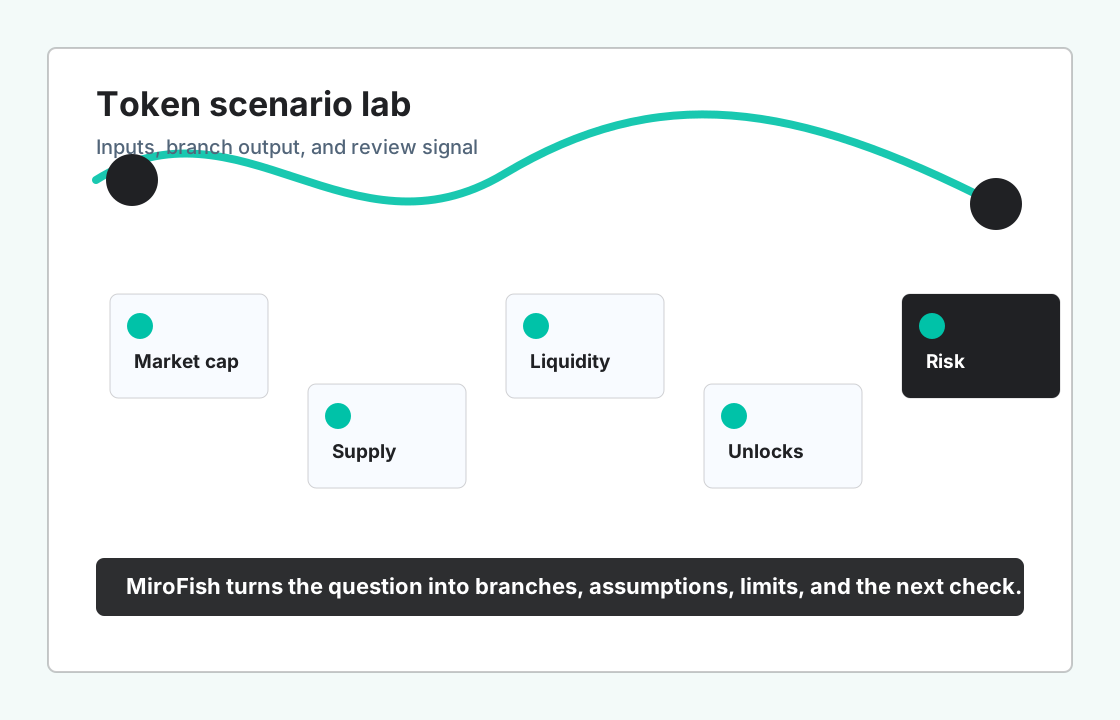
Use current supply and a future supply branch when unlocks matter.
Thin liquidity can make a calculator output unusable in practice.
Name the catalyst and the group that must believe it.
Assume the narrative fails or supply expands faster than demand.
One calculator, three branches
| Market cap branch | What has to be true for the target market cap to make sense? |
|---|---|
| Supply branch | What happens if circulating supply or unlocks change faster than demand? |
| Liquidity branch | Can the market absorb the move, or is the output just spreadsheet precision? |
Token lab
crypto price prediction calculator: connect math to market risk
A crypto price prediction calculator can look exact while resting on fragile assumptions. Market cap divided by supply is simple; the hard part is deciding whether the market cap target, circulating supply, liquidity, unlock schedule, and demand story make sense together. A useful page keeps those pieces in the same view.
The reader should see more than a price box. Show target market cap, current and future supply, fully diluted context, liquidity, exchange depth, catalyst, and downside branch. If supply expands faster than demand, the same market cap story can produce a different price path. That is why the calculator needs branches.
MiroFish can help compare narratives without turning them into trading commands. Paste the token assumptions, source links, catalyst claim, unlock dates, and risk notes. Ask for bull, base, and bear branches that explain what would have to be true. The result should be research support, not advice.
Crypto pages need a stronger risk line than ordinary calculators. Volatility, thin liquidity, custody risk, regulation, smart-contract risk, and narrative cycles can all break a neat estimate. Put those risks near the result so the calculator does not feel more certain than the market is.
A helpful CTA asks the reader to test assumptions. It should not say "predict the price" as if the answer is locked. It should say bring the market cap target, supply schedule, liquidity context, and downside case, then review the branch output before acting.
Market cap target
Name the comparable asset or adoption story behind the target, not just the number.
Supply path
Include circulating supply today and a future supply branch when unlocks matter.
Liquidity reality
Check whether the market could absorb the move implied by the calculator.
Risk branch
Describe what happens if the catalyst fails, liquidity thins, or supply expands.
Reader arrives with
A token, a market cap target, or a quick price scenario.
Best first action
Gather supply, market cap, liquidity, unlock, and catalyst assumptions.
Best MiroFish output
Bull, base, and bear token branches with non-advisory risk notes.
Claim to avoid
A crypto price prediction calculator that tells a reader to buy or sell.
Use MiroFish when the inputs are visible enough to challenge. The console should make a crypto price prediction calculator less brittle: market cap, supply, liquidity, and risk all shown before the branch output.
Working notes
How to use this crypto calculator workflow without overclaiming
The best version of a crypto calculator workflow is specific, dated, and easy to review. A reader should understand the official facts, the assumptions, the entertainment or research boundary, and the last check that belongs outside the model before they follow a call to action.
Facts to keep visible
Crypto asset risk: The SEC warns that crypto assets can be highly volatile and speculative. Calculator pattern: A common simple price estimate divides target market cap by circulating supply. Supply matters: Token unlocks and circulating supply changes can alter a price estimate even if market cap assumptions stay the same. These details make the page useful because they give the reader a factual anchor before any scenario, calculator, quiz, or number note appears.
Comparison examples
MarketCapOf is useful for seeing market cap comparison calculator and price output; CoinMarketCap Academy is useful for seeing supply and FDV explainer; CoinGecko is useful for seeing price, supply, market data context. Those examples show common reader expectations, but the MiroFish page should still add a clearer review path, a safer boundary, and a natural next step into the console.
For crypto calculator workflow, the first pass should not try to sound final. It should collect the smallest complete packet of evidence: the exact game, market, match, draw, quiz context, or calculator input; the source that confirms the official rule; and the assumption that would change the conclusion. That packet lets the reader see why the output exists.
The Variables lane turns the topic into action. Target market cap: The story behind the number matters more than the number itself. Circulating supply: Use current supply and a future supply branch when unlocks matter. Liquidity: Thin liquidity can make a calculator output unusable in practice. Demand narrative: Name the catalyst and the group that must believe it. If one of those pieces is missing, the page should say what must be checked next. That is more helpful than a confident sentence that hides uncertainty.
The console handoff should be phrased as a working brief. Ask MiroFish to compare branches, label weak evidence, and name the review signal that would make the draft safer. Do not ask it to promise a score, a winning ticket, a baby outcome, an investment result, or a guaranteed match pick.
Reader trust depends on boundaries. Is this investment advice? No. It structures assumptions and risks; it should not tell a reader to buy, sell, or hold. Why include supply? A price estimate changes when circulating or fully diluted supply changes. What should be checked last? Current supply, liquidity, unlock schedule, exchange data, and the catalyst claim. Those answers belong close to the call to action because they explain what the page can do and what it cannot do. A clear boundary makes the CTA feel useful instead of pushy.
The final review is simple: confirm the official source, refresh any time-sensitive input, remove certainty language, and keep the next step aligned with the reader's real task. If the reader wants more context, the predictions hub provides adjacent workflows; if they are ready to build the brief, the console is the right destination.
The SEC warns that crypto assets can be highly volatile and speculative.
Check sourceA common simple price estimate divides target market cap by circulating supply.
Check sourceToken unlocks and circulating supply changes can alter a price estimate even if market cap assumptions stay the same.
Check sourceConsole handoff
Send the token assumptions, not a trading command
Build a crypto price prediction calculator brief for research only. Include market cap target, circulating supply, future unlocks, liquidity, demand narrative, bull/base/bear cases, and a clear non-advisory risk note.
Open console with token assumptionscrypto price prediction calculator FAQ
Is this investment advice?
No. It structures assumptions and risks; it should not tell a reader to buy, sell, or hold.
Why include supply?
A price estimate changes when circulating or fully diluted supply changes.
What should be checked last?
Current supply, liquidity, unlock schedule, exchange data, and the catalyst claim.